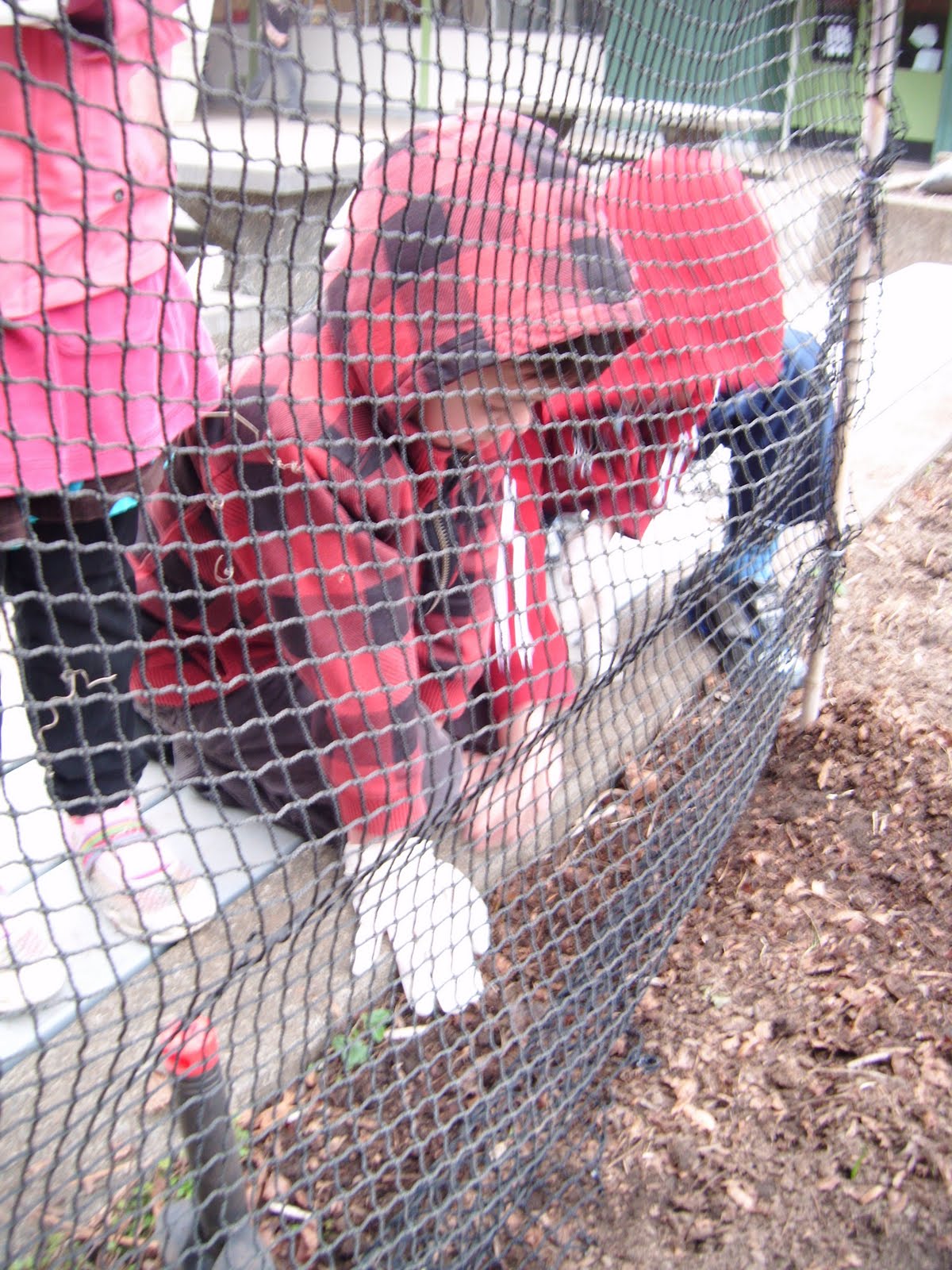
Although the Kindergardeners did an excellent job on the stepping stones, I personally needed to learn from a few errors I made along the way.
First, most of the stepping stones split broke or even completely crumbled when they dried. The reason being is, of course, my husband and I didn't poor the concrete thick enough--the circular plastic plant container trays we had used as molds had these ridges on the inside-bottom (to ensure a container would be slightly raised to allow water to drain in, I suppose). The stones cracked right along these ridges like pieces of a pie.
Second, I had purchased the cheapest, lowest grade concrete mix out there. I was warned about all the pebbles and debris in this kind of mix, but thought, hey, it would just make the stepping stones more "rustic" in appearance. Unfortunately, it also meant there was more rock and rubble instead of concrete, and this made it difficult for the concrete to set into a solid mass. All the pebbles also made it challenging for the children to write in the stones, or to make leaf impressions.
Third, I ignored the on-line suggestion to add a thin screen or wire mesh when pouring the concrete into the molds (about half-way deep), to help provide internal structural support.
Finally, I heeded the on-line suggestion to wait 10-20 minutes for the concrete to set enough for the kids to write in it with a stick (which didn't really work anyway, because of all the rocks). However, I found the concrete dried so fast, that by the time the last group of kids came out it was hard for them to press the marbles, shells, etc. I supplied into the stepping stones.
I had taken the stepping stones to cure at my place. When they broke, I decided to try and repair them as best I could. I sifted the pebbles out of the remainder of the mix I had left, and made a smoother, more workable concrete. I poured the mix into the molds, added a bit of screen this time, poured in a bit more mix, then placed the pieces of the Kindergardeners' stepping stones on top, matching up the pieces as best I could.
It worked! When I checked up on the stones a week after I put them in the school garden, only one had crumbled, and 4 remained solid. They don't look quite as nice as when the children first did them, but hey, live, learn and grow, right?
Wednesday, June 16, 2010
Wednesday, June 9, 2010
"A Little Dirt Could Make Kids Smarter" (Victoria Times Colonist Article, May 25, 2010)
Parents, here's another reason for your kids to play outdoors in the dirt: It may make them smarter.
And, as a side benefit, dirt appears to be a natural anti-anxiety drug, but without the side-effects.
Mice exposed to a bacterium found in soil navigated a maze twice as fast, and with less anxiety, as control mice, in studies presented yesterday at the 110th general meeting of the American Society for Microbiology in San Diego.
The researchers say we've become so urbanized we risk losing a connection with an organism in nature that may actually be beneficial to humans.
Dr. Dorothy Matthews became intrigued by mycobacterium vaccae -- a natural soil microbe -- in 2007, when British scientists published a study showing that when mice were injected with a heat-killed version of the organism, it stimulated neurons in the brainstem to start producing serotonin.
"Serotonin is a molecule that has a number of different effects, but one of them is modulating mood and decreasing anxiety," says Matthews, an associate professor of biology at The Sage Colleges in Troy, N.Y.
Serotonin also plays a role in learning. "If you're nervous, if you're frightened, you just can't think straight," Matthews said. She wondered, could M. vaccae have an effect on learning in mice?
She and her colleague, Dr. Susan Jenks, also a professor of biology, dabbed the bacteria onto tiny peanut butter sandwich squares made with Wonder bread.
In one experiment, they tested how long the mice took to navigate a maze, which illustrates how quickly the rodents were learning whether they needed to turn right or left.
The bacteria-exposed mice consistently ran the maze twice as fast as the non-exposed mice. They also showed fewer anxiety behaviours -- less freezing, wall-climbing, stopping and grooming, returning to the start, or defecation.
In other words, they were not scared poop-less.
Next, the researchers removed the bacteria from the peanut butter treats. About one week out, the experimental mice started running the mazes slower than they did when they were ingesting the bacteria. "They experienced a kind of serotonin withdrawal," Matthews said. They were still faster than the controls, on average, an effect that lasted for another month of testing.
After a three-week rest, the bacteria-exposed mice still ran the maze faster than the control mice, but the difference was no longer statistically significant.
Matthews says people are exposed to M. vaccae just by virtue of being outdoors. "If you think about it, when we look at our evolutionary history, we spent a lot of time as hunter-gatherers, or even more recently in agriculture, where we had lots of contact with the soil. It's only been the last 100 years or so that we've become more urbanized."
We no longer eat foods that we grow or gather ourselves, she says -- foods that haven't been "washed multiple times, and dunked in hot water, or processed or grown with pesticides."
Matthews doesn't know how well the bacterium aerosolizes, "but certainly if you're vigorously working in the soil, there are probably some particles that are becoming airborne, so we may very well be inhaling it, as well as eating it by inhaling it and having it get into our GI [gastrointestinal] tract."
We're also exposed via contact with food, especially foods grown directly in the soil, such as carrots and lettuce "and other things that are close to the soil."
Making time in school curriculums for children to learn outdoors may decrease their anxiety and improve their ability to learn new tasks, she says.
"There's a movement now in some schools to actually have gardens that are part of the school experience."
And, as a side benefit, dirt appears to be a natural anti-anxiety drug, but without the side-effects.
Mice exposed to a bacterium found in soil navigated a maze twice as fast, and with less anxiety, as control mice, in studies presented yesterday at the 110th general meeting of the American Society for Microbiology in San Diego.
The researchers say we've become so urbanized we risk losing a connection with an organism in nature that may actually be beneficial to humans.
Dr. Dorothy Matthews became intrigued by mycobacterium vaccae -- a natural soil microbe -- in 2007, when British scientists published a study showing that when mice were injected with a heat-killed version of the organism, it stimulated neurons in the brainstem to start producing serotonin.
"Serotonin is a molecule that has a number of different effects, but one of them is modulating mood and decreasing anxiety," says Matthews, an associate professor of biology at The Sage Colleges in Troy, N.Y.
Serotonin also plays a role in learning. "If you're nervous, if you're frightened, you just can't think straight," Matthews said. She wondered, could M. vaccae have an effect on learning in mice?
She and her colleague, Dr. Susan Jenks, also a professor of biology, dabbed the bacteria onto tiny peanut butter sandwich squares made with Wonder bread.
In one experiment, they tested how long the mice took to navigate a maze, which illustrates how quickly the rodents were learning whether they needed to turn right or left.
The bacteria-exposed mice consistently ran the maze twice as fast as the non-exposed mice. They also showed fewer anxiety behaviours -- less freezing, wall-climbing, stopping and grooming, returning to the start, or defecation.
In other words, they were not scared poop-less.
Next, the researchers removed the bacteria from the peanut butter treats. About one week out, the experimental mice started running the mazes slower than they did when they were ingesting the bacteria. "They experienced a kind of serotonin withdrawal," Matthews said. They were still faster than the controls, on average, an effect that lasted for another month of testing.
After a three-week rest, the bacteria-exposed mice still ran the maze faster than the control mice, but the difference was no longer statistically significant.
Matthews says people are exposed to M. vaccae just by virtue of being outdoors. "If you think about it, when we look at our evolutionary history, we spent a lot of time as hunter-gatherers, or even more recently in agriculture, where we had lots of contact with the soil. It's only been the last 100 years or so that we've become more urbanized."
We no longer eat foods that we grow or gather ourselves, she says -- foods that haven't been "washed multiple times, and dunked in hot water, or processed or grown with pesticides."
Matthews doesn't know how well the bacterium aerosolizes, "but certainly if you're vigorously working in the soil, there are probably some particles that are becoming airborne, so we may very well be inhaling it, as well as eating it by inhaling it and having it get into our GI [gastrointestinal] tract."
We're also exposed via contact with food, especially foods grown directly in the soil, such as carrots and lettuce "and other things that are close to the soil."
Making time in school curriculums for children to learn outdoors may decrease their anxiety and improve their ability to learn new tasks, she says.
"There's a movement now in some schools to actually have gardens that are part of the school experience."
© Copyright (c) The Victoria Times Colonist
Thursday, May 27, 2010
Concrete Stepping Stones Part 1--It's The Journey, Right?
I count blessings because by far the biggest challenge is to keep the kids from stepping on small plants as they struggle to grow from beneath hopping, skipping, and jumping feet. This garden, after all, is the students' garden, their space to play and explore.
Gardens and children are a natural equation. They just go so well together: I find children have that natural scientific curiousity and wonder for all life forms, be it green or blue, earthbound or winged. In my observation, I have noticed the children intentionally avoid stepping on the plants in the courtyard garden--they make a game of it--but little sprouts just peeking out from the soil are not easily seen, and most children don't even know they are growing there to even try to avoid them.
So, following the lead of Puntledge garden coordinators in the past, many volunteers agreed that stepping stones would be a good idea.
I found a diy stepping stone website and the whole process seemed simple enough, and research told me the project is fun to do with children. There are many types of concrete you can buy, but considering we are a public school and on a budget, I bought the cheapest stuff available. There was a warning: this type of concrete can work, but it is extremely pebbly. Never mind, I thought, the pebbles will just add to the rustic charm of the overall project.
My husband said he would help me out with the stepping stones. Once again, I had arranged to do this activity with Mme. Messer's pm kindergarten class. The kids were to come out (we had set up just outside the classroom door) in groups of 4 or 5.
My husband and I decided we would pre-mix the concrete away from the children, by the car in the school parking lot, since the powder is an inhalation hazard (we wore masks and eye protection). According to instructions, if we wanted to have the children write in the stepping stones, we should let the concrete set for about 20 minutes. We only had time to wait for about 10 minutes, but even then, the concrete set so fast, children in the later groups had trouble pushing in the shells, marbles, and stones my husband and I had collected for them to decorate with. The pebbles in the concrete mix didn't help either, and they couldn't really write anything in the stepping stones, unfortunately. A few plant prints were made, but even then, it was difficult to make the prints look clear.
Despite this initial setback, the class appeared to have lots of fun! They wore gloves and smocks to protect skin and clothing, but other than that, there isn't much difference between decorating a concrete stepping stone and decorating a mud pie!
However, for me, more challenges were to come, and more lessons learned.
Friday, May 14, 2010
Thursday, May 13, 2010
April 22: Planting a Native Garden on Earth Day
First off, a shout out to my mother-in-law for allowing me to collect (non-restricted) native plants from her property.
As I drove into the school parking lot on Earth Day, I was at first befuddled by the fact that there were no other cars there. Then it dawned on me: it was walk/ride to school day! I felt a bit guilty--the irony not lost on me--that I had driven up to
the school to plant Native plants in recognition of Earth Day. Groan.
The picture above was taken on Earth Day, as students enjoyed the bright sunshine and even brighter tulips as they read by the courtyard garden.
Planting the native garden was a great success! Earlier in the month, I had contacted Aboriginal Kindergarten teacher Susan Leslie to see if her class would like to help me with the native plants, and she said yes! The previous year's kindergarten has just published an interpretive book on the plants in the streamside forest running along the school property, and this year's class also did activities around the same topic. Once again, I was blown away at how knowledgeable and enthusiastic the children were helping me out in the garden. Together we planted oregon grape, native columbine, salmonberry, huckleberry, vanilla leaf, false lily-of-the-valley and--oops--what turned out to be Siberian miner's lettuce. I meant to use the other native variety--it is far tastier! Sword ferns were already there.
Hopefully the native garden will include lilies and wildflowers for early spring interst and more native edibles, and will become an established and (more or less self sufficient) garden of beauty, history, and diversity! We are so fortunate at Ecole Puntledge to have such a beautiful natural surrounding, and such a diverse population of students to learn from.
Thanks to the Kindergarteners from Ab Ed!
Wednesday, April 7, 2010
April 1: 100 Pea Project (Kindergarten Children Help Plant 100 Snap Pea Seeds)

The afternoon French immersion kindergarten class helped me plant 100 pea seeds (les "petit-pois," I love it!) in the courtyard garden. I had given the children the seeds for their 100 days of Kindergarten celebration with the intention of planting them in the garden, and Mme. Messer has been very supportive about getting the children to participate.
It was a cold and drizzley day, but the K-students toughed it out and did an excellent job planting and "tucking the seeds in" with little blankets of soil. Many of them shared stories about their favorite vegetables and bugs, and many said how much they enjoyed helping mom, dad and grandparents in the garden. A big "merci" to Mme. Messer and her pm kindergarten class!
And another big thanks to Mme. Chow's grade 7 students who helped me prepare the bed the day before. They worked really hard and helped me get the bed ready in at least half the time. What is more, they shared some fabulous ideas which I hope we can incorporate into the garden, and they came with almost more garden knowledge than myself! Thanks again!
Tuesday, April 6, 2010
The History of Peas
Peas are a cool weather crop and gardeners can enjoy a spring and fall harvest. They are easy to grow and a children mealtime favorite. Because of their mass appeal, peas have been grown for centuries. Their exact origin is unknown, but peas could have come from either Egypt or China.Emperor Shu Nung, an avid plant collector, found a pea plant while wandering the Chinese countryside 5000 years ago, and began cultivating it for human consumption. Shu Nung's plant discoveries were first tested on a dog, and then on a slave, to see if they were safe enough to it.
The Norse believed that the god Thor rained pea seeds down upon them as a punishment, but the peas grew where they landed and the people began to eat them. Peas were also found in ancient Egyptian tombs, and in the Middle Ages, Europeans dried peas as a reserve in times of famine (dried peas store for a very long time). The early Americans who emigrated from Europe depended on peas to help them survive. In the 17th century, people began to eat peas fresh and they were soon considered a delicacy (the above historical information gathered from http://gardening.wsu.edu/library/vege006/vege006.htm)
And we all know the children's rhyme: "Pease porridge hot, pease porridge cold..."
The peas in the Puntledge school garden are "Sugar Daddy" sugar snap peas, a semi-dwarf variety with edible pods. Peas are rich in anti-oxidants, iron, vitamin C, B 6, magnesium, and many other nutrients.
Subscribe to:
Posts (Atom)